As you can probably gather from the primary URL for this website, it largely covers the sub-section of video games inspired by popular comic books and superheroes.
But, when you’re asked if you want to read Doom Guy: Life in First Person early and interview John Romero, a game designer you’ve followed since you first became a teenager, you make an exception and bend the rules a little. What follows is a transcript of a 30-minute conversation I had with John Romero discussing his new book which drops this week.
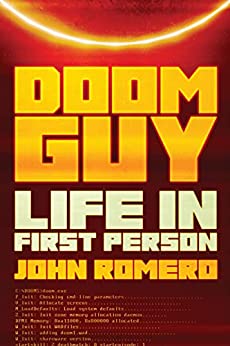
COMIC BOOK VIDEO GAMES: In the opening of the book, you describe an event where you’re in Canada, and instead of talking about your games, you were asked to instead talk about your personal life. In the beginning section, there’s a lot of that, so I wanted to ask if it was hard or cathartic elaborating on this for Doom Guy?
JOHN ROMERO: I think I was really glad to get it out there. Because a lot of people don’t know where I came from. What A lot of people may know is that “oh hey, you’re from California” and they don’t know that I’m actually Mexican. I’m from Arizona and lived in Tucson for the first eight years of my life. There’s a lot of fans that love DOOM and they like to learn more about the people that make their games and that information wasn’t out there anywhere. So, it felt like a good addition and a choice to write the story from when I was born until now and put it out there.
CBVG: In the early days of your career, you talk about turning around games in a manner of months, which is kind of shocking because modern games take so long to make. Matt Booty from Xbox is saying now that it will take 5-6 years for a AAA experience. So I wanted to ask if you have nostalgia when you could turn around games so quickly either on your own or with id?
ROMERO: Yeah, it was really fun back then to put out things so quickly. Even in the Apple II era, I could put out games in a few days or a few weeks and it was really great practice. But when you make a game that fast, you really limit what you can make. So, I was always actually excited for being able to spend more time to make a game. And really, Wolfenstein 3-D was the first time where we all felt “hey we have enough time” because we didn’t know how long it was going to take and we didn’t have a final date on it. So it was the first time we just go “lets make a really great game and not worry about how long it takes us” even though it was four months to get to the shareware!
Nowadays, it does take longer because there’s a lot more complexity in the tools, and the creation of all the assets takes longer. But, it depends on the team size and the game’s scope. You can make an indie game on a decent speed with a small team.
CBVG: From the opening where you talk about your childhood growing up, and being a happy kid but not having a lot, and then going to the days when DOOM absolutely blew up. What was it like having your hard work pay off and changing your life?
ROMERO: It’s funny because I focus more on what I’m doing and where I’m going way more than say, money. My trajectory from the Apple II days has always going up because I was always learning so much stuff and making lots of games. Sometimes I would make a big game and it was pretty cool and I was really excited that I made something that big. Then I would reach a highlight point where I got my first industry job. That was such a big deal, and I feel that I was so much further along the path being able to do that, to have my first full time game industry job.
Then to work with John Carmack, Tom hall and Adrian Carmack all together for the first time was a huge milestone and it turned out really, really well. And then forming the company together, everything we were doing was going up. It was funny, because the way we looked at the money part of it was this is great! We don’t have to worry about where the money is coming for a while and we can just focus on making something really great. To me, that’s the recipe for success for a really great game is to not worry to have to worry about the money but the game itself. That’s where the money was more impactful for us because it enabled us to keep making cool stuff.
CBVG: I actually went back and watched the first time I saw John Romero was on The Electric Playground –
ROMERO: Oh yeah, Victor Lucas!
CBVG: I went back and watched one of the interviews and people think “here’s these rock stars” but in reading Doom Guy the business section where you guys just banked so much money, the realization that it’s important to have this just in case something doesn’t work out fund. So yeah, these guys are rock stars, but also very, very responsible.
ROMERO: Even in 1991 and we were starting to make good money, we made more money than what we needed to live. We had enough to move the company, to buy a file server, new computers, all that kind of stuff. That, to us, was more important, because that’s what we needed to keep on making doing what we’re doing. It wasn’t like “oh wow, we have the money to buy a new car!” that was never the goal. The goal was to make something great. We knew, money would follow if we did something truly great, and even from those early days, it worked well for us because we almost never had to worry about money because we were doing so well and spending so little that we knew that we were on a really great trajectory and wanted to keep that going.
CBVG: I don’t want to keep on this one subject, and I’m going to jump around a little, because something that touched me was you talking about coming off of that where when DOOM blew up and you decided to help your parents. In me reading the book, what I began to think about was this something I would do around your age and I would like to think I would have, but I don’t know. What was it like to pay back your family and the importance of your familial relationships?
ROMERO: I had a really tight family, and I felt it was critical to give back to the community and my family, especially coming from a poor background. If anybody in the family does well and can share that, then that’s great. Helping them have a better life or get over a problem, so it was really great. I thought that was nice, and to me, I got into programming because I was really excited about learning how to code and to make things. Even back then, I never thought about how technology could be so transformation to people’s lives, and if you can make good money, you can actually help people with it. I wouldn’t be anywhere without my families’ love and support over the years.
CBVG: Something I noted, because I watch a YouTube channel called Stop Skeletons From Fighting, and I’m pretty sure they’ve covered every single port of DOOM. There’s a moment during the Wolfenstein 3-D era and you mention that there was an Atari Lynx version. How far along did that get and how would something like that even work?
ROMERO: We spent probably 3 weeks or so, converting all of the graphics over to the Lynx, and in 1991, when the Lynx came out, we loved it. We played every game on it, it was so good. Commander Keen’s wrist computer was a Lynx, we just scratched out the logo. If you get Commander Keen 4, you’ll see that the menu system is his arm on a Lynx screen but the Lynx name is scratched out.
So in 1992, when we were talking about Wolfenstein 3-D, we thought hey, this would be great to do this on the Atari Lynx. We formed a relationship with Atari and they were just like, we would love to have Wolfenstein 3-D on that system to help sell it. We got it running on there, we got the graphics converted and started on getting the rasterization working. It wasn’t long after that, around the same time, they asked us to come up with their mascot character like Mario or Sonic. So we came up with a character named Pounce but then they went under and went bankrupt so we couldn’t put out that Lynx version.
CBVG: That’s why I love the Atari 50: the Anniversary Collection from Digital Eclipse last year, because where I live, the game selection was very limited. So the Atari Lynx is not something I have a lot of experience with, so I loved getting this education on these things that I never had.
ROMERO: Yeah I really liked Electrocop.
CBVG: The way hardware is now, the sky’s the limit, and for me personally, I love to read about creative programming challenges where they make the impossible happen. Something like Dragon’s Lair on the Game Boy Color that shouldn’t exist. I miss those things.
ROMERO: It’s funny nowadays because people are doing that. The latest version of DOOM is running on a CPU cooler screen, and that’s cool, but what blows me away, is when DOOM is running on a Vic-20. That’s more impressive, because those machines had no hardware for anything!
CBVG: The success of DOOM allowed you to bring in people who were making things for it like American McGee, who went on to make the Alice series, and then you got to support Raven Software who went on to make the excellent Wolverine game. Was there a sense that you got to pay it forward, or was it your ability to recognize talent?
ROMERO: Yeah, it was funny, with Raven they were a random find. I just saw that they were advertising for a programmer while being in Madison, Wisconsin in the classified section of the newspaper. I said “Raven, that sounds like a game company” so I called them up and basically went over there and said hi to everyone in the Winter of 1991. I tried to get them to work with us at the time, and it wouldn’t be until the beginning of 1994 until I got to work with them on a game.
They did the best medieval style graphics at the time, Black Crypt looked so good. We recognized their talent and that they were a small team and Ben Goeke was a really great programmer. Finally getting to work with them, even though they were mostly unknown at the time, I knew they had huge potential. Getting them on Heretic was really, really great. Later on, years later, I helped them form Human Head when they left Raven. Ion Storm funded them at the beginning and now they’re Roundhouse Studios.
CBVG: You bring up Masters of Doom at points throughout DOOM Guy, and I wanted to ask what was it like adding context to that book as someone who lived through these events?
ROMERO: I was mostly just adding information because I can’t say how he (David Kushner) got his information. From my viewpoint, here’s some extra information that might help make things clearer. He spent 5 years making that book so he did a lot of research.
CBVG: In reading Doom Guy, you understand that you’re someone who just loves to make things. When you get to the section about Quake, I just thought “I really want to play this game!” but, living in the present, I know what happens. You’re very proud of how Quake turned out, but was it hard to come in and work on it when you were passionate to make one thing and then it became another? How does that affect you creatively?
ROMERO: So, the design of that game had been percolating for many years because of our Dungeons & Dragons adventures. When we were finally working on the tech it was like, “yeah, I can’t wait to make that thing happen” but because in game development, things change over time. When you start developing a game, you have an idea of what that game is, but because of the nature of game development, it almost is never the game that you set out to be exactly, it changes it some way.
When we did have our big meeting and found out that the team really didn’t want to have 2 R&D cycles, they just wanted to make the game. My goal then was basically delivering the best game we could, so I never came into work not liking what I was doing, I love making games. So even though the design had changed, I was still super excited about it. Whatever the thing is you’re making, you do your best on it.
We had amazing technology that had been worked on for a year, no one else had it, whatever we were going to was actually going to turn out pretty great. We had tons of FPS experience, so it wasn’t like we were making something unknown. We knew it was going to be great. I didn’t think we knew it was going to be our last game, but that’s how it was meant to be because of the time and the struggle to get it done. I’m super proud of Quake because it turned out to be an incredible game.
CBVG: What I was trying to do when reading Doom Guy was to put my self in someone’s shoes, because you wanted to be there, but you also wanted to make the other game, and what that felt like.
ROMERO: Let me just add that I love making games, and if that idea couldn’t happen at that time, it doesn’t mean that it couldn’t happen some time in the future. So, there’s never a “oh no, we can’t make it” well, we won’t make it right now, but maybe we’ll make it later. There’s always a positive result: we’re going to do the best we can right now, maybe later we’ll actually get to do that.
CBVG: It’s something I have in my review of Doom Guy is that people know you from this era, it just feels like you’re getting started.
ROMERO: When I say that, I’m not saying that I’m working on that game. Everyone has ideas for games. If we had the same idea DOOM as another dev team that started at the same time, we would’ve never made the same game as the other team. That’s just how game development goes. I’ll always be making games.
CBVG: I think there are many people who will be happy to hear that.
I was taking notes when I was reading, and very early on I wrote the note “I wonder how much of his work he saved?”. Then you bring up a story later in the book that I won’t spoil because I want everyone to read the book. You’re looking towards the future but we have companies like the Video Game History Foundation and others who are working hard to preserve video game history. How important do you think video game preservation is today and do you think enough is being done?
ROMERO: Oh, so much is being done, you have no idea. We’re taking whole research departments at universities. The saving of games that are on disc or cartridge is not a problem. Digital Eclipse, as you know, is incredible at emulation past hardware. The hardest thing right now is to save and recreate the network topology of a giant game like World of Warcraft. When that game goes away, how do we bring it back? How do we see it again? The amount of servers that make that game work is massive.
Lots of people got rid of a lot of their materials, but I saved all of myself, and if you want, I can show you a cool id history thing.
At this point, I was shown something beyond amazing that I’m not entirely sure I’m at liberty to discuss so I’ll keep it vague. I will say that it’s talked about it Doom Guy: Life in First Person that you should all check out as soon as you can!
I would like to deeply thank John Romero for giving up his time to speak with me, as well as Abrams Press for granting me early access to Doom Guy: Life in First Person and setting up the interview.
Doom Guy: Life in First Person by John Romero is available this week from Abrams Press.
You can read my review of Doom Guy: Life in First Person HERE.


 Comic Book Video Games
Pingback: REVIEW: DOOM GUY: LIFE IN FIRST PERSON BY JOHN ROMERO | Comic Book Video Games
Pingback: INTERVIEW: THE LEGENDARY JOHN ROMERO TALKS DOOM GUY: LIFE IN FIRST PERSON – Today all. in one masti