AUTHOR’S NOTE: The writer of this article was given an advance look at FPS: First Person Shooter.
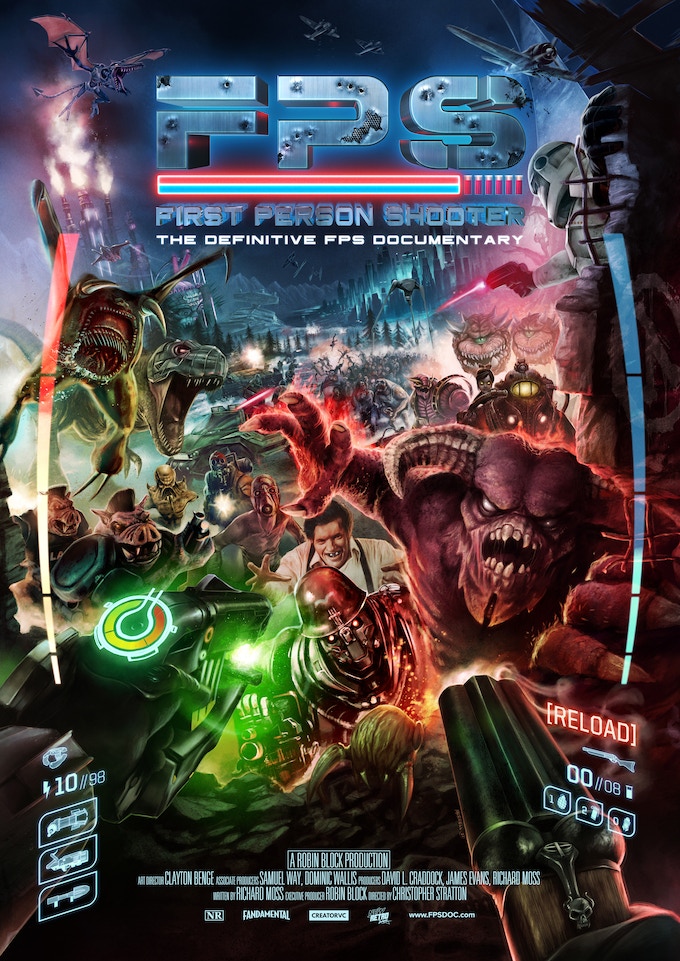
First-person shooters, which not a few decades ago people referred to as “DOOM clones” after id Software’s ground breaking title spawned an ocean of imitators in the then unnamed genre , are still among the most played today. In fact, as this review is being written, 2 major platform holders are locked in battle over the future Call of Duty, the FPS franchise that doesn’t show any sign of slowing down.
The history of the first-person shooter and its rise to prominence is the subject of the aptly titled FPS: First Person Shooter, a documentary written, produced and directed by author David L Craddock. Craddock’s books, such as book Long Live Mortal Kombat: Round 1: The Fatalities and Fandom of the Arcade Era, are known for being thoroughly researched tomes of almost encyclopedic knowledge and with FPS, he applies that level of craftmanship to the language of film. The result is a highly entertaining, not to mention informative, look at over 50 of the biggest shooters across several decades that is a must-watch for anyone with even a passing interest in the history of video games.
Clocking in at 4-and-a-half hours, FPS: First Person Shooter‘s length might seem daunting, but when you consider how many of us consume content nowadays on streaming platforms, not to mention its brisk pacing, you won’t feel the runtime at all. Conveniently, FPS is broken up into various eras too that serve as digital bookmarks, from the genesis of first-person video games in titles like Maze, or Maze War, to the rise of id Software and shifting of shooters from PC to home consoles.
Ultimately FPS is built to consume it however you wish, whether that’s by binging it in its entirety or pacing yourself over several sessions. Whatever route you take, FPS is designed to entertain just as much as it is to educate. Interstitial graphics evolve to show retro tech that at the beginning feels straight out of James Cameron’s Aliens and eventually these morph into modern displays as the film rolls on. These are accompanied by well timed and edited jokes and retro commercials that aren’t afraid to poke some fun at the industry FPS is trying to celebrate. Each technique is used brilliantly to keep the documentary lite and never once does it feel wholly academic or stuffy.
As engaging as it can be, to simply take FPS as a full course meal is to almost do it a disservice though, because there’s just so much to take in. For example, you might’ve thought that first-person shooters started with id Software with the likes of Wolfenstein 3-D and DOOM, but here you learn about their humble beginnings in games like Colony, which honestly can be hard to look at because of the technology it was constructed with, but you can’t take your eyes off it. To hear about how something like that was built where one disc was used just for sound is astounding, and it’s material like this that makes FPS so terrific.

Featuring over 40 contributors, from id Software alum like John Romero, John Carmack and Tom Hall to newcomers like David Oshry, the CEO of New Blood Interactive which is the studio behind Dusk, FPS shines the spotlight on passionate developers, actors, and journalists who want nothing more than talk about the games they’re either made or loved. Hearing the John’s from id Software reminisce about the creation of DOOM and Quake never gets old, and that’s true even if you’ve read something like Masters of DOOM from front to back. Jon St. John, the voice of Duke Nukem, has a spot talking about how taking a job voicing a character in a video game when such things were never heard of changed his life, and it really shows just how the FPS genre forced innovation into the gaming landscape.
The creation of DOOM led to LAN, or local area networks, where people would meet up with their PCs to compete against one another. This fed into networked matches online and the creation of esports. Unreal, from Gears of War creator Cliff Bleszinski who makes appearances here, spawned the Unreal Engine tool set and the business of selling off the shelf tech to aid in development. Though not a traditional shooter, Deus Ex, from Looking Glass Studios with a team fronted by Warren Spector, would go on to show how the first-person perspective could be used to tell immersive stories. All of these facets and so much more are featured here and help bring some much positivity to the shooter space. Shooters, no matter what the perspective they’re played from, can sometimes get viewed negatively for being mindless run-and-gun power fantasies, but FPS: First Person Shooters show that they can be so much more.
Given what and who is featured in FPS: First Person Shooter, one can only imagine the daunting task of assembling it into the form that will go out to viewers. That being said though, the absence of certain creators and important pieces of software can be felt somewhat. Seamus Blackley, who was instrumental in the creation of the original Xbox, was a driving force behind the maligned Trespasser: Jurassic Park, a game that for all its faults had impressive physics that inspired one Gabe Newell to create a game you might’ve heard of called Half-Life.
Blackley and others are featured talking about how transformative Half-Life is, but Gabe Newell is nowhere to be found. That’s not to say that Craddock and his team didn’t reach out to them, as you can probably wager a large sum of money they did, but it’s a shame they couldn’t work something out. Another Valve title, Left 4 Dead, doesn’t get a lot of screen time either, and it’s surprising that for all of the hits that get their moment in the spotlight, Bioshock and its sequels are nowhere to be found even though System Shock is.
As FPS begins to wind down, it starts to move into the post-Halo era where first-person shooters begin to migrate to consoles. Halo, of course, is prominently shown, but other big shooters from the console space are almost put in a quick lightning round. For a minor spoiler for those who are interested in the source material for this site, Turok: Dinosaur Hunter is one of the 50+ games here, and while its importance is stated, especially how it had a Native American lead front and center, it or its sequels don’t get the full FPS treatment.
If every piece of software was highlighted as thorough as say DOOM, FPS: First Person Shooter would be 24 hours long, and who knows, perhaps if this turns out to be the success it should be, it could lead to more. It’s easy to ignore what FPS isn’t, because what you’re getting in this jam packed documentary is one of, if not the, most comprehensive look at the first-person shooter space to date in this celebration of the first-person shooter and the passionate community of creators and fans who cherish them. If you on any level see yourself as a student of video game history, you need to check out FPS: First Person Shooter.
You can pre-order FPS: First Person Shooter starting today HERE.


 Comic Book Video Games
Pingback: REVIEW: DOOM GUY: LIFE IN FIRST PERSON BY JOHN ROMERO | Comic Book Video Games
Pingback: TERRORBYTES: AN UPCOMING DOCUSERIES ABOUT HORROR GAMES INCLUDING THE WALKING DEAD | Comic Book Video Games