DEVELOPER: Art of Play Interactive
PUBLISHER: Art of Play Interactive
REVIEWED ON: PlayStation 5 from a copy purchased by the author.
Thanks in no part to Teenage Mutant Ninja Turtles: Shredder’s Revenge, beat ’em ups have seen a resurgence in the past few years. Properties like G.I Joe, Toxic Crusaders and Mighty Morphin Power Rangers have gotten, or will in the future, a throwback brawler akin to something that tried to suck the allowance out of your pocket at the arcade or the rental store counter. An addition to that list is The Phantom from Melbourne based Art of Play Interactive inspired by the character who debuted in comic strips dating back to 1936. The Phantom features some crisply drawn backgrounds and a clear admiration for some all time arcade classics, but its loose feeling blows and low-frills package won’t excite many save die-hard fans of The Phantom in a post Shredder’s Revenge world.
If you have no history with The Phantom, either from comics, the 1996 live-action film or the futuristic reboot Phantom 2040 in the 90s, Art of Play’s video game gets you caught up to speed in the opening motion comic. For centuries, one family has passed down the purple-clad costumed mantle of The Phantom along with a pact to destroy piracy, greed, cruelty and injustice. When a false alarm pulls The Phantom and his partner Diana away from their home, the Skull Cave, they return to find it looted by the pirate band known as the Singh Brotherhood. On top of that, their son Kit has been taken hostage and thus The Phantom and Diana start a globe-trotting adventure to rescue their son while punching a lot of pirates along the way.
The product page for The Phantom touts that the animation is led my well-known Marvel and DC artists, but they’re not named. None immediately jumped out in the credits either. Regardless of who’s responsible, The Phantom‘s best feature is easily it’s art. The backgrounds give the feel like you’re moving along the page of the comic, and the character design is sharp too. The motion-comics that move the story from the jungles of the fictional nation of Bangella, the rooftops of India and a snowy train in Sweden put to shame those used in higher budget productions like Marvel’s Avengers and Suicide Squad: Kill the Justice League. They even use comic book framing devices like speech balloons to accompany what little voice over is present and jump from panel-to-panel instead of just having static still images.
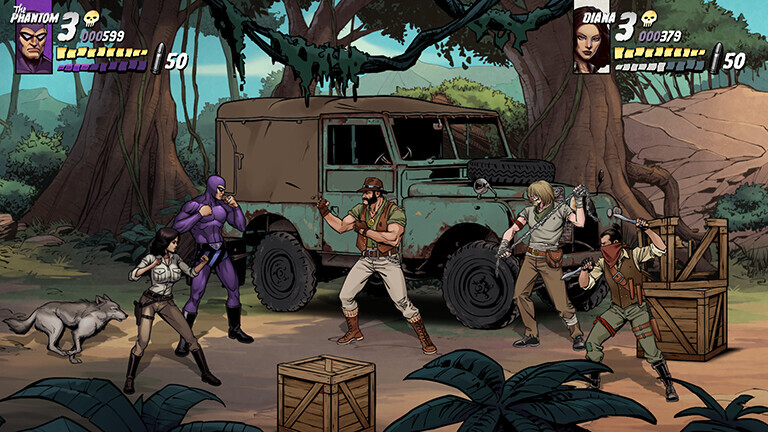
If only the moment-to-moment action could match the production value, The Phantom could’ve perhaps been a sleeper hit, but the repetitive action is simply okay and fails to excite. The Phantom has a spinning clothesline that evokes Final Fight‘s Mike Haggar and when someone catches on fire from an explosion, it’s copy and pasted right out of Street Fighter II. You can even destroy cars either with your fists or tree stumps picked up off the ground. Clearly there’s an admiration for the hits here, but beat ’em ups have evolved beyond just trying to evoke nostalgia of a bygone era.
You can play as either The Phantom or Diana, or both via local co-operative play, and their repertoire is what you expect from a game like this. You can punch, kick, throw, and expend a meter that you build up by landing hits for charge attacks and a devastating auto-combo when it’s full. Collision detection is fine, but too often it felt like enemies could break free from being stunned and deal unfair hits while you’re stuck in a combo. You can toggle screen shake and there’s some vibration, but the hits don’t feel like they have that special sauce that gives them that extra bit of flavor. The music, which Limited Run Games is pressing to a CD for the special edition of their physical release, lacks any real energy that will move you along from the left to right, and sometimes back to the left again. It has an international flair that helps to define the regions, but it’s in one ear and out the other.
The Phantom as a character doesn’t have any superpowers to speak of, but there are elements unique to his mythology that are used to help make this average brawler slightly stand out. Both The Phantom and Diana can draw their pistols and shoot to fight enemies at a distance provided they have ammo. Each can summon an animal to stun an enemy – The Phantom can call upon a wolf while Diana has an eagle – but your companions aren’t overly that helpful and most of the time you’ll forget you have them. They’re not valuable in the same way the over-the-top mutant powers in Konami’s X-Men were that saved you from a nasty mob or heavy.
To break up the action between stages, you’ll briefly ride on vehicles like The Phantom’s horse, Hero, a car and a boat where you have to dodge obstacles while shooting at a boss. They’re welcome diversions, but once you’ve seen one, you understand how the rest work. As the size of your transportation increases, you’ll also take cheap hits because it’s hard to thread the needle between sea mines and grenades that are too close together.

Unlike Shredder’s Revenge that expanded upon the simplistic brawler formula by adding a rudimentary leveling system, new moves and challenges, The Phantom shows its hand in its first three stages. There’s nothing really to collect save some public domain antiques linked to The Phantom’s history and money that increases your score count. Racking up points won’t grant you a spare life, in fact you can’t expand them at all but you do have unlimited continues, so you’ll get annoyed whenever a power-up crate pops up that doesn’t either have health or ammo in it. If you start a stage with 0 lives, it’s best to take the loss and continue else you’ll be punished by having to repeat your progress as you start back at the beginning each time, even on easy.
Each area has its own enemy type, India for example has sword and shield wielding guards while New York features gangsters packing tommy guns, but you’re effectively bashing on the same few goons throughout the five territories. That’s a criticism that can be lobbed against any beat ’em up really, but it’s more noticeable when the action feels stale. What bosses are present are unremarkable at best and tedious at worst. 2 of the last fights require you to drain a health meter down to near nothing, only for you to see your opponent jump off screen and fill it back up at least 3-4 times. In between recharges you have to deal with mobs too.
Upon rolling credits, about all there is to do is unlock an arcade and endurance mode that really just have you playing through the same content just with different rules. If you play by yourself, you can go back and try the other character, but there’s very little difference between The Phantom and Diana to warrant doing this really.
The credits for The Phantom are quite brief compared to many modern games, and you can tell from the art and throwbacks to other games that there’s some passion behind this project. The Phantom doesn’t overstay its welcome, but it feels longer than what it actually is because it simply devoid of the fast-paced excitement that makes you not want to put your controller down. This is a game that wants to remind you of games like Final Fight and Streets of Rage, but such reverence to the past prevents it from keeping up with far better contemporaries.
The Phantom is available now on Nintendo Switch, the PlayStation 4/5 and PC. Physical editions for Nintendo Switch and PlayStation 5 can be pre-ordered through Limited Run Games HERE.


 Comic Book Video Games