
DEVELOPER: Capcom
PUBLISHER: Capcom
REVIEWED ON: Nintendo Switch from a digital copy purchased by the author.
AUTHOR’S NOTE: This review will focus on the offline offerings of the game exclusively.
Marvel in the mid-90s was far from the pop culture juggernaut it is now. Where nowadays it’s a branch of a multi-billion dollar corporation, there was a time when Marvel Comics was a struggling entity that entered into bankruptcy, and, thankfully, came out on the other side. It was around this time that Capcom started a relationship with Marvel and for over half a decade released titles starring the likes of Spider-Man, the X-Men, and Captain America among countless others both on home consoles and in the arcade. This partnership would eventually culminate in the beloved fighting game crossover Marvel vs. Capcom 2: New Age of Heroes.
Capcom would make stop-and-start deals with Marvel to bring back their classic catalog of games with the rise of digital distribution, but it has been nearly a decade since their last release, 2012’s Marvel vs. Capcom: Origins, was delisted for purchase. Despite their popularity and hunger from the public at large, it looked like the only way to access the likes of X-Men vs. Street Fighter and Marvel vs. Capcom: Clash of Super Heroes would either be through emulation, the pricey secondary market, or the equally expensive – not to mention space consuming – offerings from Arcade1Up.
It’s for those reasons that a palpable level of excitement could be felt across the world when during a Nintendo Direct In June, Marvel vs. Capcom Fighting Collection: Arcade Classics was unveiled to a shocked public. A compilation that was desired but thought to be but a pipedream was seemingly willed into existence to the point where it almost didn’t seem real. Now after a short wait – for all but Xbox only users anyway – Marvel vs. Capcom Fighting Collection: Arcade Classics has been released onto digital stores and it’s everything that people have been thirsting for and more. With the amount of games included in the package, not to mention the bonus material, this is a game that you need to fit into your budget whether you have experience with these classics or not.
Marvel vs. Capcom Fighting Collection: Arcade Classics includes 7 games:
- The Punisher
- X-Men: Children of the Atom
- Marvel Super Heroes
- X-Men vs. Street Fighter
- Marvel Super Heroes vs. Street Fighter
- Marvel vs. Capcom: Clash of Super Heroes
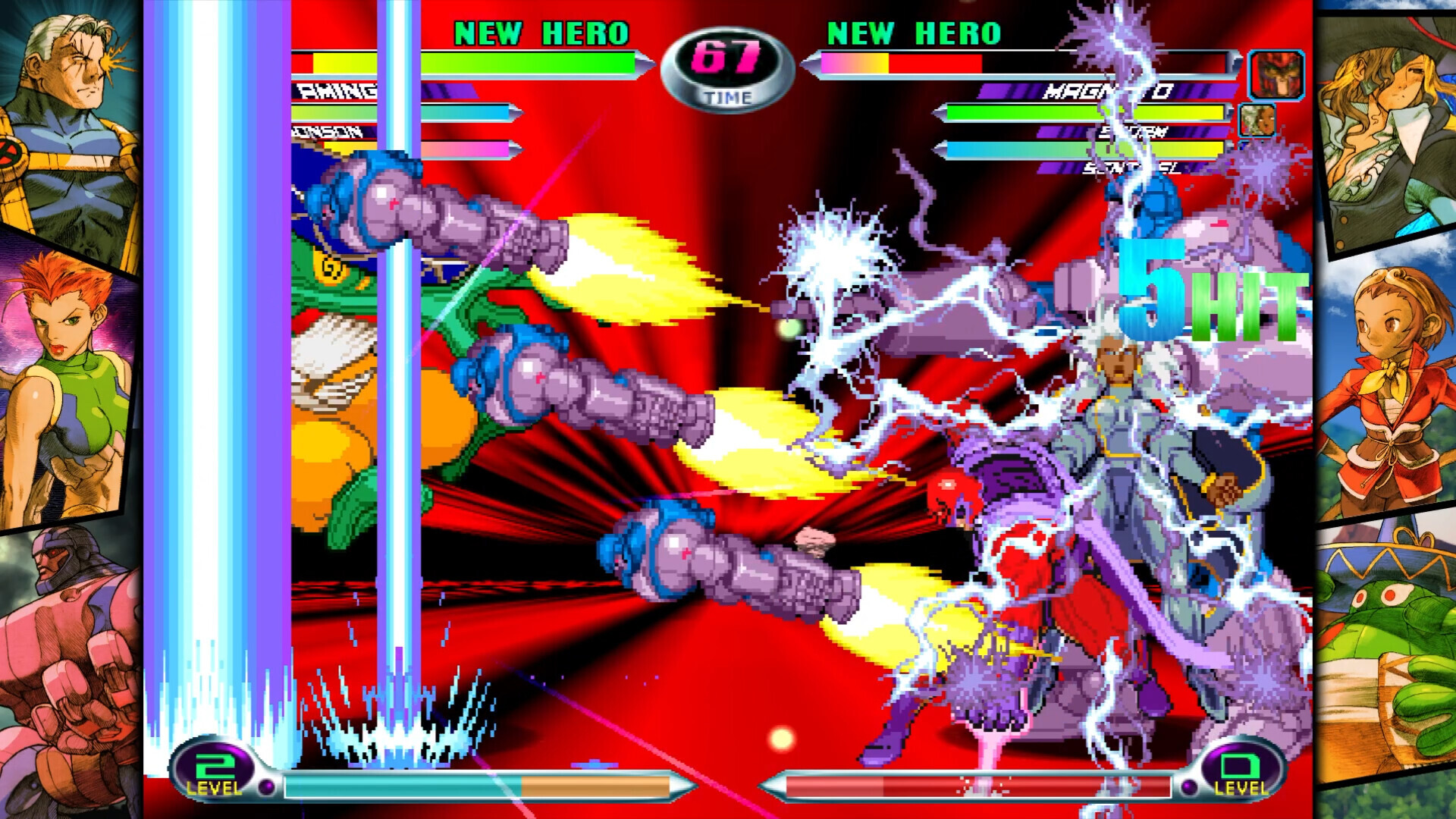
- Marvel vs. Capcom 2: New Age of Heroes
The Punisher, a game that until now only saw a home conversion to the Sega Genesis/Mega Drive, is a scrolling beat ’em up while the others are fighting games. Despite the lack of genre variety in the collection, not to mention the reused assets you’ll see from game-to-game, each have their own unique hook beyond roster swaps. Marvel vs. Capcom: Clash of Super Heroes is a love letter to both camps in how it uses its roster, music and backgrounds, while Marvel Super Heroes has a mechanic wherein Infinity Gems can be used to augment your fighter. Marvel vs. Capcom 2: New Age of Heroes with its jazzy, unforgettable soundtrack, massive roster and 3v3 battles needs very little introduction.

No matter the game, what sells each even to the uninitiated is the passion and admiration for not only Capcom’s own stable of characters, but to the borrowed source material from Marvel as well. Heroes and villains like Cyclops, Spider-Man, Doctor Doom and Magneto are illustrated here by insanely talented Japanese artists both in promotional art and the phenomenal sprite work on display, yet they still feel like they’re taken straight from the pages of the monthly comic books that spawned them. These projects were never Capcom reinterpreting beloved for a new audience, but rather honoring and celebrating them in one of the best ways possible.
This also translates to how they move in combat as well. Spider-Man is a fast character who can swing about the screen, while Gambit litters the screen with kinetically charged playing cards. No matter the game, or the team size you bring into a fight, their truly is a character for players of all skill levels and that’s exactly what makes all of these games so magical.
The Punisher as a character is known for lethal force with just about every firearm imaginable, yet works surprisingly well in the context of a quarter munching brawler. Capcom even found a way to incorporate guns into the tried-and-true formula as temporary power-ups, and it’s what makes The Punisher stand out amongst a sea of beat ’em ups based on popular licenses here.
The rest of the games owe much to Capcom’s template that they started all the way back in Street Fighter II but with many alterations to make the combat as stylish as possibly. On the base level, each fighter has 3 punches and kicks that come in light, medium and heavy flavors with special attacks activated by combining those with quarter and full-circle motions. These can be joined with advanced mechanics like air juggles and tag attacks that simply lend themselves to exhilarating brawls.
What made the Vs. Series so approachable at the time compared to its contemporaries, namely Capcom’s own Street Fighter Alpha sub-series, was the lowered bar of entry to newcomers. Marvel vs. Capcom and its brethren are known for their over-the-top attacks where characters either fly about the screen or litter it with enormous beam attacks that dish out massive damage. In Street Fighter Alpha, players would have to pull off cumbersome 2 x quarter-circle motions that was moved back to just on in all the games here as a means to level the playing field. This is just one way in which the Vs. Series lends itself to a broader audience.
Ideally, most of the games here are best played on an arcade stick. A concession in the Fighting Collection for controller play is the ability to map things like multiple punches and kicks to a spare trigger, making moves that require multiple button presses even simpler to pull off. If you want further assistance, you can even map a super attack to a push of a button. The benchmark for Marvel vs. Capcom ports were the ones built for the Sega Dreamcast, and while they’re technically excellent, not to mention beautiful, the base controller for that device did not lend itself to fighting games. For review, Fighting Collection was tested both with a Switch Pro controller and the Hori Splitpad Pro in portable mode. I’m by no means a competitor in any of these games, merely a beloved admirer, and I was able to comfortably pull off tags and hyper combos with little difficulty.
Keener eyes intimately familiar with the arcade original or Dreamcast ports might notice a problem here or there, but everything in the package to most will look and feel exactly like it did back in the day. Like many compilations, the screen can be adjusted to fit your playstyle, various background borders can be applied to fill out the playing field and filters can be overlaid to simulate the arcade monitors of old.
Fighting Collection isn’t merely just a way to experience old games though as it comes with bonus features as well that will more than please people who have been longing for this package. There’s a jukebox of sorts where you can play your favorite track from every game and hundreds of pages of concept art to sift through. This includes everything from arcade marquees, promotional art for characters, and behind-the-scenes sketches of the design process. It’s almost as fun to dig into these as it is to play, however a better curation of them would’ve been appreciated. You have to move through each one-by-one with no way to filter just the design documents for example, and it makes it somewhat of a chore to get to what you truly want.

Included here is a training mode that will give you visual information like hit boxes, but as a tool to new players, it could be a little better. If anyone has viewed videos of any game included here, they’ve seen crazy air combos and crossover team-ups, but Fighting Collection doesn’t really explain how do them. It will tell you how to knock an opponent in the air, but not what to do once they’re up there. Given these games are either 30 years old or approaching that, there’s plenty of online resources at anyone’s disposal, but something akin to what’s featured in the likes of the Injustice games that feature basic combo strings would’ve been appreciated.
It’s hard to look at something this perfect and demand more, but it’s a little disappointing not to see the console exclusive X-Men: Mutant Apocalypse and Marvel Super Heroes in War of the Gems here. This is meant to be a celebration of the arcade, but with those 2 on the roster, this would’ve truly been the ultimate compilation of Marvel/Capcom games from that era. Both have been on Arcade1Up cabinets, and it’s hard to see Capcom releasing 2 SNES games on their own or to a service like Nintendo Switch Online. Unless a 2nd volume is coming that’s focused on home games and includes the altered PlayStation ports from the 90s/00s but that’s doubtful.
Despite a few nitpicks, Marvel vs. Capcom Fighting Collection: Arcade Classics is a phenomenal celebration of some of the greatest games ever built, licensed or otherwise. Every game looks, feels and sounds exactly like you remember and plays superbly whether you’re using a controller or an arcade stick. From a preservation perspective alone, Fighting Collection is well worth its asking price. Considering the depth of nearly every title housed within, you’ve got something you can easily lose hours into whether you’re a first time player or someone who once stood around an arcade machine, quarter in hand, eagerly awaiting your turn.
Marvel vs. Capcom Fighting Collection: Arcade Classics is available now on the PlayStation family of consoles, Nintendo Switch and PC digitally. Physical copies are coming for the PlayStation family of devices and Nintendo Switch on November 22nd.
Xbox users can expect a digital release of Marvel vs. Capcom Fighting Collection: Arcade Classics sometime in 2025.


 Comic Book Video Games
Pingback: NEWS ROUND UP: TMNT: SPLINTERED FATE GETS NEW DLC AND MARVEL VS. CAPCOM SHADOW DROPS ON XBOX | Comic Book Video Games