With a long-running TV series now packed into his ring and a big-budget film now under their iconic yellow belt, The Flash’s stock in the public eye has certainly risen within the last few years. One area in which the Scarlet Speedster has yet to truly break in though is video games. The Flash has sped his way through many ensemble titles, but the last time an attempt was made to craft a title starring them, it never made it to market due to the mismanagement of a now defunct publisher called Brash Entertainment. This also led to the closure of BottleRocket Entertainment, a studio best known for creating the PS2 cult favorite The Mark of Kri.
You can learn about that in the below video produced by Liam Robertson for Did You Know Gaming?
To date, the best solo outing spotlighting the Scarlet Speedster is Justice League Heroes: The Flash, a side-scrolling brawler companion piece to Justice League Heroes developed by WayForward Technologies that landed in 2006. Arriving on the Game Boy Advance when both the Nintendo DS and Sony’s PlayStation Portable had hit their stride, not to mention the impending launch of the Wii and PlayStation 3, Justice League Heroes: The Flash feels like it has become mostly forgotten despite garnering favorable reviews during its release.
Those who have played it, however, have come to realize exactly how much of a hidden gem it is and how superbly it uses the character in the brief, but highly enjoyable, action title. With The Flash landing in cinemas, the appetite for players to zip around Central City and other iconic DC Comics locales as The Fastest Man Alive in games like these is only going to grow bigger. It’s for that reason why I reached out to Adam Tierney, the director of Justice League Heroes: The Flash, to share their experience working on what can still be considered the best Flash video game nearly 2 decades after it landed on store shelves.
COMIC BOOK VIDEO GAMES: Where did the idea of a Flash-centric tie-in game to Justice League Heroes come from? Was it Warner Bros. shopping the idea around, or did WayForward specifically pick this toy out of the toy box?
ADAM TIERNEY: If memory serves, WB Interactive approached us about doing a GBA companion game to Justice League Heroes and we pitched them on the idea of focusing primarily on The Flash (with the other heroes as jump-in assists).
CBVG: Once you had the character locked down, when was the decision made to place The Flash in the context of a side-scrolling beat ‘em up?
TIERNEY: There was a previous The Flash Game Boy game that was a sideview platformer, but that genre didn’t provide much running space for the character. We knew that we wanted The Flash to zip around similarly to how a soccer ball was passed in top-down soccer video games. So naturally it made sense to have that sort of top-down 3/4 perspective to best allow the character to run around in the environment.
CBVG: WayForward is known for high quality sprite work as well as animation and that’s certainly on display with Justice League Heroes: The Flash. The Flash in particular looks stunning in motion as he jogs and zips about the environment. Describe the process in getting the run cycle for The Fastest Man Alive just right.
TIERNEY: First and foremost, we decided early on to make the sprites TINY. A lot of Game Boy and GBA games had massive sprites, which really limited your navigation options. Going with tiny sprites helped add more area for The Flash to run around, allowed us to get more enemies onscreen at once, and also cut down animation time (because there were fewer pixels to render).

CBVG: This game interweaves between the events of Justice League Heroes proper. How much contact did you have with Snowblind Studios, the developer of that game, to make sure the events in your game lined up correctly?
TIERNEY: Close to none, I think. Any coordination on locations, bosses, and events was probably handled through our communications with WB Interactive, who would’ve also been working with them. My recollection was that we pitched WB on a number of enemies, bosses, and locations and then some were approved and some weren’t. We got very close to having Bizarro as a boss in there, I recall.
CBVG: Easily one of the best mechanics in Justice League Heroes: The Flash is the ability to quickly dash between enemies with the tap of the A button and then follow-up with a flurry of blows. Can you remember how this came about and what challenges there were implementing into the game’s levels?
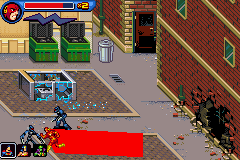
TIERNEY: As mentioned, The Flash zips between enemies the same way players pass a soccer ball in 8-bit soccer games. That was our initial idea for the game and ended up being the primary mechanic. I would say one challenge was coming up with secondary attacks that worked with the fewer buttons on the GBA. So while zipping between enemies and doing basic punches worked great, other moves like the kick or circling around enemies were a bit clumsier, and in hindsight maybe we could’ve skipped adding those moves.
CBVG: Justice League Heroes: The Flash gives a tour across the DC Comics landscape as you travel from Keystone to Gotham and even Themyscira. Was it challenging building a story that linked these environments whilst staying within the confines of Justice League Heroes? How did you go about picking the areas you wanted to use?
TIERNEY: It was just leaning into what we love. Gotham City? Let’s get Arkham Asylum in there, and also have you walk down Crime Alley. Themyscira, Metropolis, the Daily Planet rooftop, etc. We just went with the most memorable visual landmarks we could think of from DC Comics that would fit each area and upcoming boss battle. The story was then largely strung together after we had all the rest decided.
CBVG: The Flash is joined by fellow League members Superman, Wonder Woman, Martian Manhunter, Green Arrow and Black Canary who you can summon to aid you. How did you go about selecting this roster?

TIERNEY: I believe we chose the characters that WB told us were main characters in the console game. In hindsight, it’s a bit odd to have Martian Manhunter in there along with the similar-powered Superman, but no Green Lantern or Batman. We also reused VO clips from the console game during the call-in attacks, so that might’ve played an element in which heroes we selected, too.
CBVG: Each area is capped off with terrifically designed boss fights with famous DC Comics villains like Gorilla Grodd, Killer Frost and Brainiac among others. What went into not only picking what villains Flash would go up against, but how the fights themselves would work? Were there any bad guys you wanted to use but just couldn’t fit in?
TIERNEY: I think we wanted a big Joker + Harley battle, but couldn’t do it for some reason or another. We got further with Bizarro, who I remember we had at least a sprite model of. In general, we wanted to start with Grodd (who is primarily a Flash adversary) and then expand to other villains throughout the DC universe. I believe we picked whoever we thought looked coolest or had the best powers per location, which is how we landed on Killer Frost, Circe, etc.

CBVG: The standout fight in the entire game is the race with Zoom with that design being brilliantly repurposed for the bonus epilogue which is a friendly showdown with Superman. Explain how you went about designing the race stages and how the Superman extra came to be.
TIERNEY: Yeah, I thought those sequences came together pretty well. The levels are made up of many smaller chunks of horizontal stage that the game then strings together during gameplay, because our level design tool couldn’t handle stages that long. Pixel artist Nick Lee (who now works at WayForward as an art director) was a genius at constructing levels with tight limitations on tile counts and color palettes, so he figured out how to make all the pieces and get everything overlapping so characters could go in front of and behind things. Once we had that section done with Zoom, it seemed like an obvious gameplay addition to repurpose it for the classic Flash vs. Superman race.
CBVG: One of my personal favorite modes in this game is the “Making Of” mode that offers a glimpse into the creation of a game from pitch to final product. What made you want to add in this development insight and how did you go about truncating it to make it simple enough for an average player to understand?
TIERNEY: This was the second game I directed (after X-Men GBA), and both titles, as well as a lot of my games, are structured more like console games than handheld ones. I love having unlockable extras that add to the player’s overall experience. Things like the behind-the-scenes bonus in this game were as simple as me making a slideshow of images in Photoshop, then our programmers displaying images sequentially.
Finally, I wanted to give a shout out to The Flash’s excellent comic artist, Jason Pearson, who passed away not too long ago. Jason was one of my favorite comic book artists as a teenager, one of the best (and most unique) mainstream artists to ever work at DC and Marvel. I was so excited to get him on the project, and although his designs are definitely unusual compared to more traditional hero artists like Jim Lee, I think they were oozing with personality. The team and I own some of Jason’s original artwork from the game, which was done on paper and is gorgeous to behold in person. RIP, Jason.


 Comic Book Video Games
Pingback: EXCLUSIVE: ADAM TIERNEY RETURNS TO TALK BATMAN: THE BRAVE AND THE BOLD – THE VIDEOGAME | Comic Book Video Games